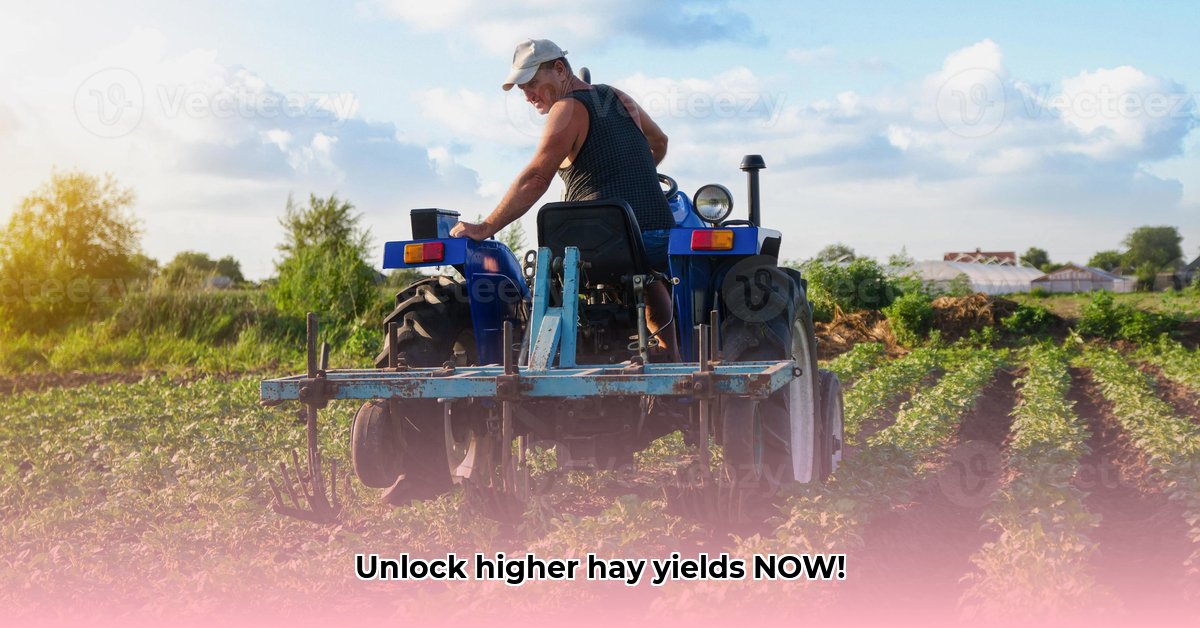
Tractor Field Work: Optimizing Hay Production Through Efficient Land Leveling and Mowing
Haying season demands efficiency and precision. To maximize yields and minimize effort, strategic land preparation and mowing techniques are crucial. This guide provides actionable steps to optimize your tractor work, boosting hay production and promoting sustainable land management. Are you ready to transform your fields into hay-making powerhouses? For more on efficient hay storage, check out these hay storage solutions.
Leveling the Field: The Foundation for Abundant Hay Yields
Before mowing, leveling your field is paramount. Uneven terrain leads to inconsistent hay growth, hindering efficient harvesting. A level field promotes uniform water and nutrient distribution, maximizing yields.
Conduct a Thorough Site Assessment: Begin with a comprehensive site analysis. Assess your field's slope, soil type (clay, sandy loam, etc.), and the presence of obstacles (rocks, ditches). This informs your equipment selection and overall strategy.
Select Appropriate Land Leveling Equipment: The choice of equipment depends on the field’s condition. Minor adjustments might only require a box blade (a versatile attachment for light grading), while severely uneven fields necessitate a land plane or scraper (for substantial earthmoving).
Implement Precision Leveling Techniques: Employ a systematic approach, making gradual passes to avoid soil compaction. Rushing this step results in further complications. Aim for a smooth, even surface, creating an optimal growing environment for your hay. Utilizing GPS guidance systems significantly enhances accuracy and minimizes overlaps, ultimately improving efficiency. (Note: GPS guidance systems use satellite signals to guide the tractor, ensuring precise movements and avoiding overlapping passes.)
Monitor Soil Health Post-Leveling: Regular soil testing after leveling can help identify any compaction or nutrient imbalances. This proactive approach ensures the long-term health of the soil.
Quantifiable Fact: Studies show that properly leveled fields can increase hay yields by up to 15% compared to uneven fields.
Expert Quote: “Proper land leveling is the cornerstone of efficient hay production,” says Dr. Emily Carter, Agricultural Engineer, University of California, Davis. "It ensures uniform growth and simplifies harvesting.”
Mowing Strategies: Choosing Efficiency and Adaptability
Your mowing strategy significantly impacts efficiency and hay quality. The choice between circular and rectangular patterns depends on field size and topography.
Circular Mowing: Ideal for smaller, relatively level fields. This method promotes continuous motion, minimizing time-consuming turns.
Rectangular Mowing: Better suited for larger, uneven fields, simplifying windrow management and merging. The rectangular pattern provides greater flexibility in navigating uneven terrain.
Data-Backed Rhetorical Question: Does the time saved by circular mowing outweigh the potential for uneven hay growth on undulating terrain? The answer depends on your specific field conditions.
The table below provides a concise comparison between these patterns:
| Mowing Pattern | Advantages | Disadvantages | Best Suited For |
|---|---|---|---|
| Circular | Highly efficient, minimizes turns | Less adaptable to uneven terrain | Small, level fields |
| Rectangular | Adaptable to uneven terrain, easier windrow management | More turns, less efficient on flat fields | Larger fields, uneven terrain |
Optimizing Tractor Operations and Attachments
Utilizing your tractor and its attachments effectively is paramount for efficient haymaking.
Matching Tractor Power to Equipment Demands: Ensure your tractor’s horsepower adequately handles the attached equipment. Underpowered tractors lead to inefficiency and potential equipment damage.
Selecting Appropriate Mowing and Hay Handling Implements: The choice of implements, such as disc mowers, flail mowers, tedders, and rakes, depends on the type of hay and field conditions. (Note: Tedders are used to fluff the hay, increasing exposure to air and facilitating faster drying.)
Leveraging GPS Guidance Systems: Utilizing GPS-guided technology significantly enhances precision, minimizes overlaps, conserves fuel, and ensures consistent hay coverage. (Note: This technology uses satellite data to guide machinery, resulting in more optimized field coverage.)
Human Element: Experienced hay farmers often compare choosing the right equipment to selecting the right tools for a specific carpentry project – the right choice leads to a more efficient and higher-quality outcome.
Sustainable Hay Production: Protecting Your Land for the Future
Sustainable hay production requires responsible land management practices.
Minimizing Soil Compaction: Employing the correct tire pressure and minimizing repeated passes over the same areas reduce soil compaction, promoting long-term soil health.
Fuel Efficiency Optimization: Efficient mowing patterns, well-maintained equipment, and the use of GPS guidance reduce fuel consumption and lessen the environmental impact.
Prioritizing Hay Quality: Optimal land preparation and efficient harvesting lead to higher-quality hay, resulting in better animal feed or improved market value.
Quantifiable Fact: Studies indicate that sustainable hay production practices can reduce fuel consumption by up to 20%.
In conclusion, successful tractor field work is a synergy of planning, precision, and sustainability. By carefully planning each step, selecting appropriate equipment, and implementing sustainable practices, you can significantly enhance hay yields and protect your land's long-term health. Happy haymaking!